- Services
- Products
-
-
- Online Training
- Information Security Awareness Training Course
- PCI DSS Compliance Bundle
- GLBA Awareness Training Course
- CMMC Training Course
- HIPAA Awareness Training Course
- Data Privacy Training Course
- Payments Security Training Course
- Phishing Awareness Training Course
- GDPR Training Course
- FERPA Training Course
- FACTA Training Course
- Online Training
-
- Compliance
- Markets
- Insights
- About

AI-generated scams, especially deepfake videos, cloned voices, and synthetic media, are no longer a sci-fi threat; they’re a real and growing risk for individuals and institutions alike.
In a higher education environment where students, faculty, and staff frequently interact online, communicate with external partners, and make decisions based on remote communications, recognizing deepfake scams is essential to protecting personal data, reputation, and institutional integrity.
With AI tools now making realistic impersonations accessible and affordable, awareness training has become a critical line of defense.
Real-World Examples of Deepfake and AI Scams
Before understanding how to defend against these scams, it’s important to see how convincingly they are already being used in real situations.
AI-Generated Voice and Video Scams
In recent years, fraudsters have used AI voice cloning and video synthesis to impersonate executives, celebrities, or known individuals in financial and social scams. For example, AI-generated impersonations of company leaders have been used to authorize fraudulent fund transfers in corporate contexts, demonstrating how convincing these attacks can be.
Deepfake Fraud Losses Surging
Deepfake scams aren’t just hypothetical. In 2025 alone, fraud attributed to deepfake technology was reported to have already cost nearly $900 million, with hundreds of millions stolen in the first half of the year.
Widespread Adoption of Scams
According to Regula, business surveys show that nearly 49% of organizations have reported experiencing deepfake-related audio or video fraud, a sharp increase over just a couple of years.
These examples illustrate how synthetic content can manipulate trust and deceive even experienced professionals, and the same tactics can target university staff, student leaders, and researchers.
Why This Matters
These examples are not isolated incidents. The data shows this type of fraud is accelerating rapidly.
- AI voice cloning and verified deepfakes are increasingly common; modern tools can create a convincing voice with as little as three seconds of audio data.
- Approximately 70% of people doubt their ability to distinguish real voices from deepfake voices without help.
- Deepfake scams, particularly voice phishing (vishing), have grown rapidly, with some data showing voice phishing incidents rising over 400% in recent reporting.
- In some sectors, deepfake attacks now occur as often as every five minutes, underscoring the scale and speed of synthetic media scams.
These statistics highlight that seeing or hearing something isn’t enough to trust it anymore, especially in high-stakes academic, administrative, or research contexts.
Best Practices for Spotting Deepfake & AI-Generated Scams
Train People to Question Unusual Communications
- Provide security awareness and phishing training to staff to keep them informed on how to spot vishing and other AI-generated fraud.
- Emphasize that any unexpected message, especially one invoking urgency, fear, or pressure, should be treated with suspicion.
- Deepfakes often rely on emotional triggers to bypass skepticism.
Verify Identity Through Secondary Channels
- If someone “calls” you via a video conference or phone with a confusing or unexpected request, verify through an independent channel (e.g., official email, known phone number, institutional directory).
- Don’t rely solely on what appears on the screen or sounds in the speaker.
Look for Technical Red Flags
- Video glitches: Look for unnatural blinking, mismatched lip movements, odd facial shadows, or swaying that doesn’t match audio.
- Audio inconsistencies: Be aware of flat, monotone speech or unnatural pauses where voice patterns seem off. Deepfake audio often lacks true breath patterns and subtle emotional cues.
Educate on Source Verification
- Encourage staff and students to verify any administrative video message or instruction against official campus announcements or portals before taking action.
- Treat any request for funds, personal data, account access, or confidential information as unverified until confirmed.
Leverage Tools & Technology
- Consider enterprise alerting or scanning tools that flag synthetic media where feasible.
- Teach users how to use basic verification tools, for example, reverse image/video search or platform reporting features, to check suspicious content.
Final Thoughts
The rise of AI-generated deepfake scams reflects a broader shift in how social engineering operates. It’s no longer just phishing emails. Today’s threats can look and sound real.
In a university setting, where trust and open communication are foundational, this trend demands proactive training and heightened awareness. By equipping students, faculty, and staff with the skills to recognize subtle inconsistencies and verify communications before responding, institutions can dramatically reduce the risk of falling victim to AI-powered fraud.
Deepfake scams aren’t going away, but with education, vigilance, and thoughtful digital hygiene, campuses can stay one step ahead of attackers.
CampusGuard’s security awareness and phishing training equip your faculty, staff, and students with essential knowledge to defend against AI-generated fraud threats. Contact us today to request a demo and get started.
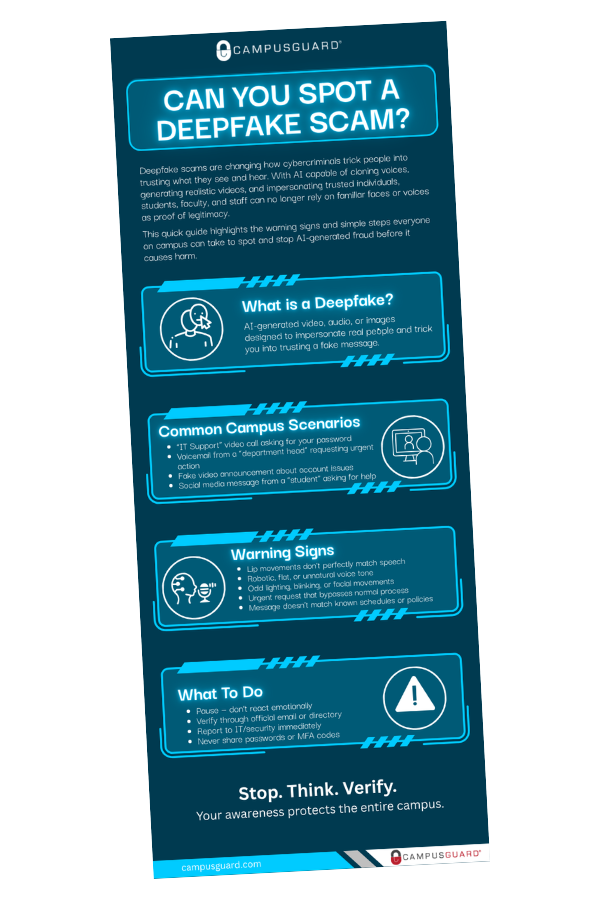
Can You Spot a Deepfake Scam?
Deepfake scams are changing how cybercriminals trick people into trusting what they see and hear.
Download our infographic, which highlights the warning signs and simple steps everyone can take to spot and stop AI-generated fraud before it causes harm.
Learn common deepfake campus scenarios, warning signs, and how to respond.
Share this guide with staff, students, and family members!
Download the Guide