

Evaluating Your Payment Environment
The goal of a Payment Assessment is to ensure that your payment processes are efficient, secure, and aligned with your business objectives.
CampusGuard’s expertise in this area can provide you with valuable insights into your payment environment, identifying any potential vulnerabilities, and presenting practical solutions to mitigate risks.
Why Choose CampusGuard for Your Payment Assessments?
By analyzing your payment processes, internal policies, and applicable laws and contracts, CampusGuard can help you make informed decisions about your payment strategy, payment solutions, and resource allocation.

Comprehensive & Actionable Guidance
We provide actionable guidance to better define, deploy, and manage how payments are accepted, disbursed, administered, and reconciled. We also offer advising, support, and assessments on your current payment processes.

Deep Experience & Accreditation
Our team possesses over 30 years of experience in banking services and payments management operational leadership and are highly qualified, holding AAP, APRP, and CTP accreditations.

Results Focused on Efficiency & Compliance
We ensure that every payment process reviewed is modern, safe, secure, and compliant, while enhancing the end-user experience. Choosing CampusGuard ensures that your assessment drives significant organizational improvement.
Types of Payment Assessments
There are a variety of Payment Assessment options available. These assessments can be done at the institutional level or at the department level, depending on your needs. You can also choose to have assessments that are tender-specific, such as cash, cards, or checks. Whatever your payment needs may be, there are assessments available to help ensure that your transactions are safe, secure, and efficient.
-
Incoming Payments Assessment
Ensure the safety and security of your incoming payments with our comprehensive assessment, which includes a review of policies, identification of payment types and locations, and a thorough analysis of potential risks and best practices recommendations. -
Outgoing Payments Assessment
Enhance the security and efficiency of your outgoing payment procedures through our thorough assessment services. We review policies, identify responsible parties, document payment flows, and recommend best practices to minimize risks and improve operations. -
Bank Account Structure Review
A banking structure assessment is a comprehensive evaluation of an organization's banking operations, designed to identify inefficiencies, risks, and opportunities for optimization. Depending on needs, this assessment may include, but not be limited to, a review of fee structures and banking agreements, account utilization, related third-party relationships, and regulatory and risk concerns. -
ACH Rules and Compliance Assessment
An ACH Rules and Compliance Assessment is a service designed to identify and mitigate potential vulnerabilities related to an organization's Automated Clearing House (ACH) payment activities. Conducted regularly, this evaluation ensures compliance with Nacha Operating Rules and helps protect against fraud, operational errors, and financial losses. A CampusGuard ACH Assessment is a holistic evaluation of possible vulnerabilities in your institutions ACH processes. The assessment utilizes the current ACH Rules and Guidelines to determine risk levels, identify controls, offer recommendations, and measure your compliance as an Originator of ACH entries.
Benefits of Payment Assessments
Compliance assessments are essential for ensuring that organizations operate in accordance with legal and ethical standards, which helps to reduce the risk of legal and reputational damage. Our assessments offer the following benefits:
-
Legal and Regulatory Compliance
Ensure that your organization meets legal and regulatory requirements, reducing the risk of legal penalties, lawsuits, and fines. -
Payments Security
We ensure that every payment process is modern, safe, secure, and compliant, while enhancing the end-user experience. -
Improved Operational Efficiency
Streamline your operations and processes, reducing the risk of errors and increasing efficiency. -
Reputation Management
Maintain a positive reputation by demonstrating your commitment to ethical and responsible practices.
Learn More about ACH & Nacha Compliance
In this video, we discuss the fundamentals of ACH and Nacha: what Nacha is and why it’s important to remain compliant with Nacha rules.
We also examine the benefits of conducting an ACH Risk Assessment and what types of findings the assessment will uncover.
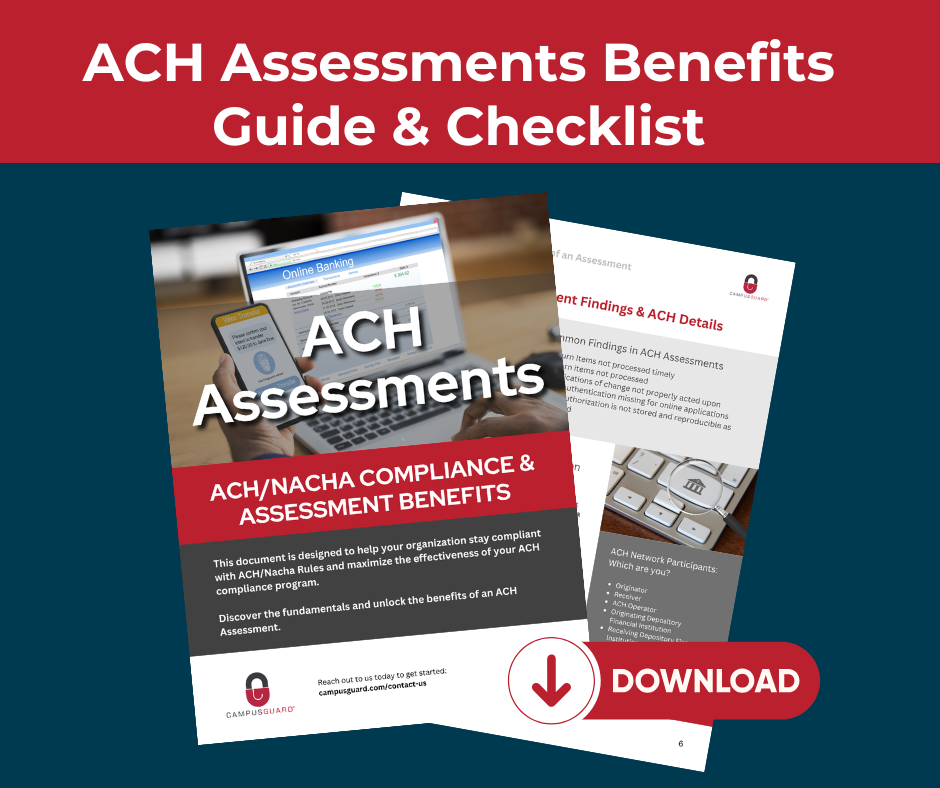
Access Our Free Guide to Unlock the Benefits of ACH Assessments
Download this free document, designed to help your organization stay compliant with ACH/Nacha Rules and maximize the effectiveness of your ACH compliance program.
This download contains:
- ACH and Nacha basics
- The purpose and benefits of ACH Assessments
- Common ACH Assessment findings and additional information
- Additional resources
Assessing Your Payment Risks
Payment assessments are critical to mitigating risks, reduce the possibility of fraud, and promote secure payment technologies for your organization. Let CampusGuard help design your risk management strategy.
Top Payment Assessment FAQs
Payment solutions are methods and tools that facilitate the transfer of money or value between parties in exchange for goods, services, or other transactions. Payment solutions play a crucial role in commerce and financial transactions, offering convenience, security, and efficiency to businesses and consumers. These solutions have evolved, adapting to technological advancements and changing consumer preferences. Here are some common types of payment solutions:
- Cash Payments: Traditional and widely used, involving physical currency in the form of coins and banknotes.
- Bank Transfers: Electronic funds transfer between bank accounts, often initiated through online banking or mobile banking applications.
- Credit and Debit Cards: Plastic cards issued by financial institutions allow users to make electronic transactions by borrowing money (credit cards) or using their funds (debit cards).
- Mobile Payments: Transactions conducted via mobile devices, including smartphones and tablets. Mobile payment solutions may involve apps, QR codes, Near Field Communication (NFC), and other technologies.
- Digital Wallets: Secure electronic systems that store payment information and can be used for online and offline transactions, such as Apple Pay, Google Pay, and Samsung Pay.
- Cryptocurrencies: Digital or virtual currencies that use cryptography for security and operate on decentralized networks, such as Bitcoin, Ethereum, and Ripple.
- Online Payment Gateways: Services facilitating online transactions by securely processing payments between buyers and sellers, including PayPal, Stripe, and Square.
- Peer-to-Peer (P2P) Payments: Direct transfer of funds between individuals without the need for traditional banking intermediaries. Platforms like Venmo and Cash App facilitate P2P payments.
- Contactless Payments: Transactions that occur without physical contact between the payment device (e.g., card or mobile phone) and the point-of-sale terminal, often using NFC technology.
- Subscription Billing Services: Payment solutions that manage recurring payments for subscription-based services.
- Point-of-Sale (POS) Systems: Integrated systems businesses use to accept payments, manage inventory, and track sales. These can include hardware like card readers and software for processing transactions.
- Bill Payment Services: Platforms that allow users to pay bills electronically, covering utilities, rent, and other recurring expenses.
A payments assessment, or a payments risk assessment, is a comprehensive evaluation of an organization’s payment processes and systems to identify inefficiencies, risks, and cost-saving opportunities.
Payments involve some risks and understanding and mitigating these risks is crucial for individuals, businesses, and financial institutions. Here are some common risks associated with payments:
Fraud:
- Payment Card Fraud: Unauthorized use of credit or debit card information for fraudulent transactions.
- Identity Theft: Theft of personal information to initiate financial transactions or gain access to accounts.
- Phishing: Deceptive attempts to obtain sensitive information, such as usernames and passwords, through fraudulent communication.
Security Breaches:
- Data Breaches: Unauthorized access to and theft of sensitive payment information stored by businesses or financial institutions.
- Malware and Hacking: Attacks on computer systems or networks to gain access to payment data.
Chargebacks:
- Friendly Fraud: Customers dispute legitimate transactions, leading to chargebacks and potential financial losses for merchants.
Operational Risks:
- System Failures: Technical issues or outages that disrupt payment processing systems.
- Human Error: Mistakes made by individuals during payment processing that can lead to financial losses.
Regulatory Compliance:
- Non-compliance: Failure to adhere to legal and regulatory requirements, which can result in fines and reputational damage.
Currency Exchange Risks:
- Foreign Exchange Risk: Fluctuations in currency exchange rates can impact the value of cross-border transactions.
Counterparty Risks:
- Default Risk: The risk that the other party involved in the transaction fails to fulfill its financial obligations.
Transaction Risks:
- Settlement Risk: The risk that one party in a transaction fails to deliver on its obligations after the other party has already fulfilled its part.
- Timing Risk: Delays in transaction processing that may impact the intended outcome.
Technological Risks:
- Obsolete Technology: Dependence on outdated or vulnerable technologies that may be susceptible to security breaches.
Third-Party Risks:
- Vendor Risk: Risks associated with relying on third-party vendors for payment processing or related services.
Liquidity Risks:
- Cash Flow Issues: Problems related to the availability of funds, especially in situations where payments are delayed.
Reputational Risks:
- Brand Damage: Negative impact on the reputation of a business or financial institution due to payment-related issues.