- Services
- Products
-
-
- Online Training
- Information Security Awareness Training Course
- PCI DSS Compliance Bundle
- GLBA Awareness Training Course
- CMMC Training Course
- HIPAA Awareness Training Course
- Data Privacy Training Course
- Payments Security Training Course
- Phishing Awareness Training Course
- GDPR Training Course
- FERPA Training Course
- FACTA Training Course
- Online Training
-
- Compliance
- Markets
- Insights
- About

As businesses increasingly rely on electronic funds transfers, ACH payment fraud has become one of the fastest-growing forms of financial cybercrime. Automated Clearing House (ACH) payments are essential for payroll processing, vendor payments, insurance reimbursements, healthcare transactions, and B2B transfers, but they are also a prime target for fraudsters.
Unlike wire transfers, ACH transactions often rely heavily on internal approval processes and account numbers rather than real-time verification controls. This creates opportunities for business email compromise (BEC), account takeover (ATO), and vendor impersonation schemes.
Understanding the types of ACH fraud, how they occur, and how to prevent them is critical for CFOs, compliance teams, CISOs, and accounts payable departments.
Common Types of ACH Payment Fraud
1. ACH Credit Push Fraud (BEC)
ACH credit push fraud occurs when an employee is manipulated into initiating an authorized ACH transfer to a fraudster-controlled bank account. Unlike hacking a bank directly, attackers exploit human trust and payment workflows.
How It Works
- The attacker compromises or spoofs a vendor or executive email account.
- They monitor invoice communications.
- They send updated banking instructions or an urgent payment request.
- The finance team processes an ACH payment to the fraudulent account.
Because the payment is technically “authorized,” banks often classify it as a legitimate transaction.
Real-world example:
A manufacturing company lost hundreds of thousands of dollars after attackers impersonated a long-standing supplier and requested updated banking details. The accounts payable team processed the next invoice via ACH to the attacker’s account.
Why It’s Increasing
- AI-generated phishing emails are more convincing.
- Attackers conduct reconnaissance via LinkedIn and company websites.
- Remote finance teams rely heavily on email approvals.
Red Flags
- Requests for urgent or confidential payments.
- Slight domain misspellings in vendor emails.
- Sudden vendor banking changes.
- Pressure to bypass normal approval workflows.
High-Risk Targets
- Accounts payable teams
- CFOs and controllers
- Procurement departments
- Mid-sized enterprises with limited segregation of duties
2. Unauthorized ACH Debit Fraud
Fraudsters initiate ACH withdrawals (debits) from a business account without authorization.
Unlike credit push fraud, this scheme involves criminals “pulling” money from the victim’s account.
How It Works
- Attackers obtain routing and account numbers from:
- Compromised vendor systems
- Stolen checks
- Data breaches
- Public filings
- They pose as a legitimate merchant or service provider.
- Funds are withdrawn through ACH debit entries.
Because ACH relies on account and routing numbers, not card networks, it lacks built-in fraud detection like credit cards.
Why Businesses Miss It
- Lack of daily reconciliation.
- No ACH debit block or filter in place.
- Small recurring withdrawals that appear legitimate.
Real-world example:
A small business discovered recurring unauthorized ACH debits from unknown “subscription” entities. Because the activity went unnoticed for weeks, recovery options were limited.
Red Flags
- Small “subscription-like” withdrawals.
- Unknown merchant descriptions.
- Transactions outside normal billing cycles.
Key Control
Enable ACH debit blocks or ACH filters through your financial institution to restrict unauthorized withdrawals.
3. Payroll Diversion Fraud
Payroll diversion is a form of account redirection fraud where attackers reroute employee direct deposits.
How It Works
- The attacker phishes an employee or HR administrator.
- They gain access to payroll or HR systems.
- They change the direct deposit details.
- Salary payments are deposited into a mule account.
The fraud often goes undetected until payday complaints arise.
Real-world example:
Remote employees at a professional services firm were targeted in a phishing campaign. Multiple payroll accounts were altered before detection, resulting in lost wages and operational disruption.
Why It’s Growing
- Increased use of self-service HR portals.
- Remote workforce environments.
- Weak multi-factor authentication controls.
Red Flags
- Direct deposit changes right before the payroll cutoff.
- Multiple account changes across departments.
- Login attempts from unusual geographies.
Industries at Risk
- Professional services
- Healthcare systems
- Higher education institutions
- Large, distributed enterprises
4. Vendor Payment Redirection Fraud
Also known as vendor impersonation fraud, this scheme involves redirecting legitimate ACH payments by altering vendor banking records.
How It Works
- Fraudsters monitor vendor-client communications.
- They send realistic “updated ACH instructions.”
- Accounts payable modifies vendor master records.
- Future ACH payments go to the attacker.
This type of ACH fraud can remain undetected for months.
Real-world example:
A healthcare organization redirected six months of ACH reimbursements after receiving a convincing banking update email from what appeared to be a trusted billing partner.
Why It’s High Impact
Vendor payments are often large and recurring, making losses substantial.
Red Flags
- Vendors requesting secrecy.
- Banking changes without formal documentation.
- Changes shortly before large payments are due.
Critical Weakness
Failure to perform independent call-back verification using a trusted contact number.
5. Account Takeover (ATO) and Online Banking Fraud
Account takeover fraud occurs when attackers gain access to online business banking systems and initiate ACH transactions themselves.
How It Works
- Phishing or malware steals banking credentials.
- Attackers bypass weak MFA protections.
- New ACH payees are created.
- Large ACH batches are submitted.
Often executed outside business hours to delay detection.
Real-world example:
An organization discovered overnight that ACH batches totaling $1.2 million had been initiated outside normal business hours following an employee credential compromise.
Technical Methods Used
- Keylogging malware
- Man-in-the-browser attacks
- MFA fatigue attacks
- SIM swapping
Red Flags
- Login attempts from new IP addresses.
- ACH batches are submitted at unusual times.
- Creation of multiple new payees at once.
Prevention Controls
- Hardware-based MFA tokens.
- Behavioral analytics in banking systems.
- Transaction alerts and anomaly detection.
6. Synthetic Identity and Mule Account Fraud
Fraudsters use synthetic identities or recruit money mules to receive ACH transfers.
How It Works
- Criminal networks create fake identities.
- Bank accounts are opened with partial real data.
- Fraudulent ACH funds are layered through multiple accounts.
- Funds are quickly converted or moved offshore.
Why It’s Hard to Trace
- Layered transactions.
- Cross-border transfers.
- Rapid fund movement within hours.
Industries Most Impacted
- Fintech platforms
- Insurance reimbursement systems
- Healthcare billing networks
- Online marketplaces
Why Is ACH Fraud a Growing Enterprise Risk?
ACH fraud is not solely a banking issue; it intersects with:
- Cybersecurity risk management
- Internal financial controls
- Regulatory compliance (PCI DSS, SOC 2, etc.)
- Vendor risk management
- Treasury operations
Organizations that fail to integrate fraud prevention into enterprise risk management frameworks are significantly more vulnerable.
Best Practices for ACH Fraud Prevention
The most damaging ACH fraud incidents occur when technical compromise meets weak process controls. Social engineering, inadequate verification procedures, insufficient monitoring, and a lack of employee training create the perfect conditions for financial loss.
Organizations should implement layered controls combining cybersecurity, financial governance, and employee awareness training. Here are some key steps to preventing ACH fraud:
-
Implement Dual Authorization
Require two independent approvals for ACH payments and vendor banking changes.
-
Use ACH Debit Blocks and Filters
Prevent unauthorized withdrawals by restricting who can debit your account.
-
Enforce Multi-Factor Authentication (MFA)
Apply MFA to online banking, payroll systems, and accounts payable platforms.
-
Conduct Call-Back Verification
Independently verify vendor banking changes using a known, trusted phone number, not the number in the email request.
-
Monitor Accounts Daily
Enable real-time alerts for ACH batches, new payees, and unusual transaction activity.
-
Strengthen Employee Fraud Awareness Training
Train finance, HR, and procurement teams to recognize:
- Urgent payment requests
- Banking change requests
- Executive impersonation attempts
- AI-generated phishing emails
-
Segment Duties and Limit Access
Restrict who can:
- Modify vendor master files
- Change payroll settings
- Initiate ACH transactions
-
Maintain Incident Response Playbooks
Time is critical. Have documented procedures for:
- Contacting your bank immediately
- Filing fraud reports
- Preserving evidence
- Notifying impacted stakeholders
Final Thoughts: ACH Fraud Is a Business Risk, Not Just an IT Issue
ACH payment fraud is no longer an isolated accounting problem. It is a cross-functional risk involving cybersecurity, compliance, finance, and executive leadership.
As digital payments expand and AI-driven social engineering becomes more sophisticated, organizations must treat ACH fraud prevention as part of a broader enterprise risk management and cybersecurity strategy.
Strong internal controls, layered authentication, employee training, and real-time transaction monitoring are no longer optional; they are essential components of financial fraud prevention and regulatory compliance.
Organizations that proactively strengthen ACH controls today will significantly reduce financial losses, reputational damage, and operational disruption tomorrow.
CampusGuard can provide you with an insightful ACH Risk Assessment that can help you uncover potential data security or fraud risks. Contact us today to learn more and get started.
Download Our A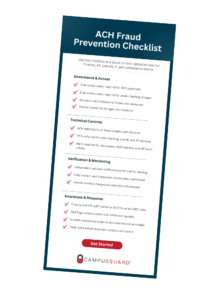 CH Fraud Prevention Checklist
Need tips to protect your organization from ACH fraud?
Use this checklist as a quick control validation tool for your finance, AP, payroll, IT, and compliance teams.