- Services
- Products
-
-
- Online Training
- Information Security Awareness Training Course
- PCI DSS Compliance Bundle
- GLBA Awareness Training Course
- CMMC Training Course
- HIPAA Awareness Training Course
- Data Privacy Training Course
- Payments Security Training Course
- Phishing Awareness Training Course
- GDPR Training Course
- FERPA Training Course
- FACTA Training Course
- Online Training
-
- Compliance
- Markets
- Insights
- About

AI-generated scams are creating new challenges for colleges and universities, where trust, collaboration, and complex administrative operations are essential to daily activities.
From fraudulent financial requests to attempts to access sensitive research data, deepfake technology can help criminals impersonate university leaders, faculty, staff, and trusted external partners. These attacks can put institutional finances, student information, intellectual property, and university operations at risk.
Protecting higher education institutions requires more than recognizing suspicious videos or cloned voices. Universities need clear verification procedures, appropriate access controls, and security awareness programs that prepare employees to respond to increasingly convincing impersonation attempts.
Deepfake Fraud Risks for Higher Education
Deepfake-related fraud has demonstrated how criminals can exploit trust in professional relationships to manipulate financial decisions and gain access to sensitive information.
For colleges and universities, similar tactics could target several areas:
University finance and payroll:
An attacker could impersonate a senior administrator to request an urgent payment, redirect a vendor payment, or change payroll details.
Research and intellectual property:
A fraudulent request could appear to come from a research partner or university leader and seek access to confidential project information or restricted research files.
Student and employee records:
An impersonator could attempt to persuade administrative staff to disclose personal information or change account details.
Third-party relationships:
Criminals could impersonate a technology provider, contractor, or funding partner to request credentials, payments, or unauthorized access.
These are potential attack scenarios, not claims that every type of attack has been documented at a university. Their significance lies in how familiar institutional workflows and trusted relationships could be exploited.
Why Deepfake Scams Require an Institutional Response
Colleges and universities often operate across multiple departments, campuses, research facilities, and external partnerships. Employees may handle financial transactions, student records, confidential research, and technology access through different systems and approval processes.
These interconnected activities create a need for consistent identity verification and authorization procedures.
Consider three institutional challenges:
- Distributed decision-making: Different departments may approve payments, manage records, or authorize access. Inconsistent procedures can create opportunities for impersonation.
- Sensitive information: Student records, employee information, and research data may be valuable targets for criminals seeking financial gain or unauthorized access.
- Trusted relationships: Employees routinely communicate with administrators, researchers, vendors, and external partners. A convincing impersonation can exploit that familiarity.
The solution is not to expect every employee to detect every deepfake. Institutions should establish safeguards that require verification for sensitive actions, even when a request appears to come from someone familiar.
Best Practices for Spotting Deepfake & AI-Generated Scams
Build Deepfake Scenarios into Higher Education Training
Security awareness programs should reflect the responsibilities of different university roles. Finance teams may need to practice handling fraudulent payment requests, while research administrators may need guidance on requests involving confidential project information.
Training scenarios should reinforce institutional approval processes and help employees understand when independent verification is required.
Establish Verification Procedures for High-Risk Transactions
Universities should define which requests require independent verification and additional approval, regardless of how authentic the communication appears.
Examples include:
- Changes to vendor banking or payroll information.
- Transfers of institutional funds.
- Requests for sensitive student or employee records.
- Access to restricted research systems or confidential data.
- Requests to change account permissions or bypass security procedures.
Verification should use established contact information and documented workflows, not contact details supplied in the request itself.
For particularly sensitive transactions, a second authorized approver can provide an additional safeguard.
Do Not Rely on Deepfake Detection Alone
Visual or audio inconsistencies may raise suspicion, but they cannot reliably establish whether a recording is authentic. Genuine recordings can have technical flaws, while convincing synthetic media may show few obvious signs of manipulation.
Universities should therefore avoid relying solely on employees’ ability to recognize deepfakes. Verification procedures, appropriate access controls, and documented approval workflows provide additional safeguards when media appears convincing.
Protect University Data and Research Assets
Higher education institutions should identify which information requires additional protection and define who can access or authorize its disclosure.
Student records, employee information, financial data, unpublished research, and intellectual property should be protected through appropriate access restrictions and approved information-sharing procedures.
Employees should know when requests for sensitive information require authorization, when external sharing is permitted, and how to report requests that fall outside established procedures.
Strengthen Institutional Security Controls
Technology can help reduce the potential impact of successful impersonation attempts. Higher education institutions should evaluate safeguards based on their systems, information assets, and risk profile.
Relevant measures may include:
- Multi-factor authentication to strengthen account security.
- Role-based and least-privilege access to limit access to sensitive systems.
- Email security and endpoint protection to help detect malicious activity.
- Device and account monitoring to identify suspicious behavior.
- Documented incident response procedures to support investigation and containment.
These controls complement identity verification and employee training. No single technology can eliminate the risk of deepfake-enabled fraud.
How Higher Education Institutions Can Reduce Deepfake Risk
Colleges and universities can reduce their exposure to AI-powered impersonation by combining governance, security controls, and employee awareness.
Establish Clear Ownership and Accountability
Identify the teams responsible for managing impersonation risks, including information technology, information security, finance, human resources, research administration, and institutional leadership.
These teams should understand their responsibilities for approving sensitive requests, escalating suspicious activity, and coordinating incident response.
Review High-Risk Workflows
Assess processes that could result in financial loss, unauthorized access, or sensitive information disclosure if an impersonation succeeds.
Prioritize payment changes, payroll updates, sensitive data requests, privileged account changes, and external sharing of research information.
Define Reporting and Response Procedures
Employees should know where to report suspicious calls, messages, video meetings, and requests for unusual actions.
Security teams should have procedures for assessing reports, preserving relevant evidence, determining whether accounts or systems are at risk, and coordinating with affected departments.
Evaluate Training Effectiveness
Training should reflect realistic university scenarios and reinforce the institution’s actual policies. Periodic reviews can help determine whether employees understand verification requirements and know how to report potential incidents.
By addressing deepfake risk through established institutional processes, universities can reduce reliance on an individual’s ability to identify synthetic media.
Build a Resilient Deepfake Response Strategy
Deepfake-enabled fraud presents a growing challenge for higher education institutions because it can exploit trusted relationships and established administrative processes.
Preparing for these attacks requires more than teaching employees to spot suspicious audio or video. Universities should establish clear verification procedures, protect sensitive information, apply appropriate access controls, and ensure employees know how to report potential incidents.
By integrating these measures into their broader cybersecurity and security awareness programs, colleges and universities can better protect institutional resources, research activities, and the campus community.
CampusGuard helps higher education institutions strengthen security awareness by preparing faculty and staff to recognize social engineering, respond to suspicious requests, and follow secure practices.
CampusGuard’s security awareness and phishing training equip your faculty, staff, and students with essential knowledge to defend against AI-generated fraud threats. Contact us today to request a demo and get started.
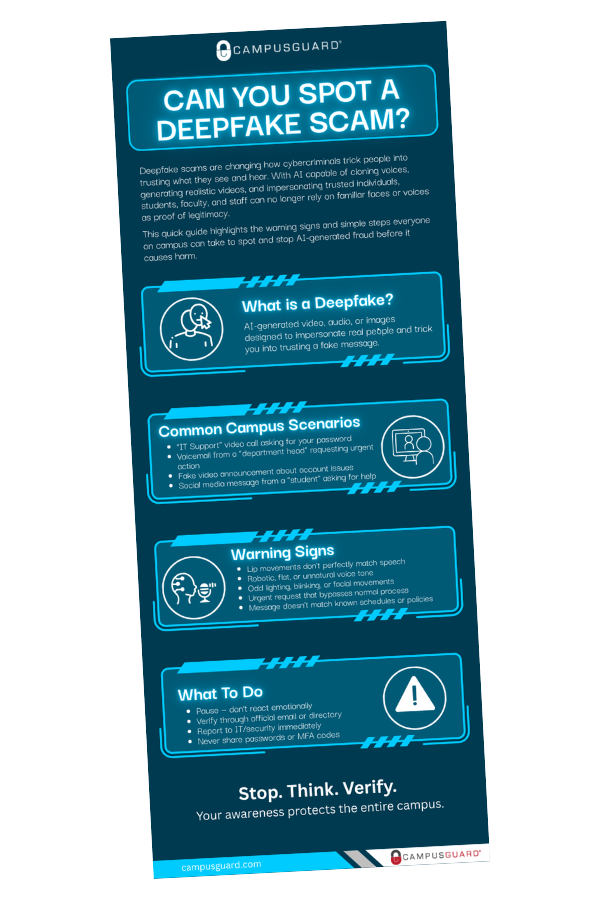
Can You Spot a Deepfake Scam?
Deepfake scams are changing how cybercriminals trick people into trusting what they see and hear.
Download our infographic, which highlights the warning signs and simple steps everyone can take to spot and stop AI-generated fraud before it causes harm.
Learn common deepfake campus scenarios, warning signs, and how to respond.
Share this guide with staff, students, and family members!
Download the Guide