
RFP Consulting Services
Optimize Payment Processes Through Tailored Consulting for RFP Management

Streamline Complex RFP Requirements
RFPs play a critical role in procurement, especially when the requirements are complex, the budget is significant, or the solution is not fully defined.
When it comes to selecting the right vendor for your payment processing requirements, CampusGuard can help you navigate the complexities of the RFP process.
Why Choose CampusGuard for Your RFP Consulting Services?
CampusGuard provides hands-on RFP support to ensure your vendor selection process is transparent, competitive, and objective. Our experienced RFP consultants bring deep expertise in payment processing and will guide your organization in selecting a vendor that is innovative, delivers high-quality service, and aligns with your budget.

Improved Clarity and Structure
Our experts ensure your RFP is well-organized, comprehensive, and aligned with industry standards. This helps vendors understand expectations clearly, leading to better, more accurate proposals.

Tailored RFP Assistance
We can seamlessly integrate into your RFP process at any stage of your timeline, offering full management or focused support like evaluations or contract reviews, customized to your needs.

Cost Savings and Efficiencies
Gain expert support in evaluating and narrowing vendor options, streamlining the selection process while reducing time and cost.
Our RFP Consulting Services
We specialize in providing top-notch RFP management and consulting services for vendor selection in the following areas:
-
Payment Processor Vendor Selection
For organizations seeking a vendor to install and manage payment processing systems, our team brings the expertise needed to guide you through every step of the RFP process. We help you identify and select a provider that aligns with your unique payment processing requirements. -
RFP Assistance for Higher Education
With deep industry and procurement expertise, we help higher education institutions identify best-fit vendors, reduce internal workload, avoid common pitfalls, and make confident, well-informed decisions that align with budget, compliance needs, and long-term strategic goals.
Benefits of RFP Consulting Services
Navigating the RFP process can be complex, time-consuming, and overwhelming—especially when critical technology, compliance, or service decisions are on the line. Partnering with an expert company provides the strategic support and industry insight needed to streamline the process, strengthen decision-making, and ensure you select the vendor that best aligns with your organization’s goals.
Below are some of the key benefits of engaging with professional RFP assistance.
-
Objective, Unbiased Evaluation
An outside specialist brings neutrality to vendor selection. We help prevent internal biases, ensure fairness in scoring, and support a transparent, defensible decision-making process. -
Access to Industry Knowledge and Best Practices
RFP consultants have deep experience across markets, technologies, and vendor landscapes. Our insights help you avoid common pitfalls and ensure your RFP aligns with current trends and compliance requirements. -
Stronger Requirements and Better Fit
Our experts help you refine your needs, craft precise requirements, and ask the right questions. This increases the likelihood of selecting a vendor that truly aligns with your goals and long-term strategy. -
Reduced Internal Stress and Workload
Outsourcing the complexity of RFP design, coordination, and communication reduces pressure on internal staff and shortens decision cycles. -
Faster, More Efficient Vendor Evaluation
Our consultants bring scoring frameworks, evaluation tools, and proven methods that streamline the review process. This improves consistency, objectivity, and project momentum. -
Enhanced Risk Management
We can identify potential risks: contractual, technical, financial, or operational—and integrate safeguards directly into the RFP. This reduces the chance of costly surprises later.
Gain Valuable Insight for a Successful RFP Process
Have you ever wondered how organizations ensure they choose the right vendor for important projects or services?
In this video, CampusGuard discusses some tips for a successful Request for Proposal (RFP) process.
If you are a Treasury Analyst, Bursar, Financial Analyst, Treasurer, Assistant Treasurer, Chief Financial Officer (CFO), Director of Treasury Operations, or a Purchasing Contract Officer, this video will help you develop a successful RFP process for your organization.
Have you ever wondered how organizations ensure they choose the right vendor for important projects or services?
In this video, CampusGuard discusses some tips for a successful Request for Proposal (RFP) process.
If you are a Treasury Analyst, Bursar, Financial Analyst, Treasurer, Assistant Treasurer, Chief Financial Officer (CFO), Director of Treasury Operations, or a Purchasing Contract Officer, this video will help you develop a successful RFP process for your organization.
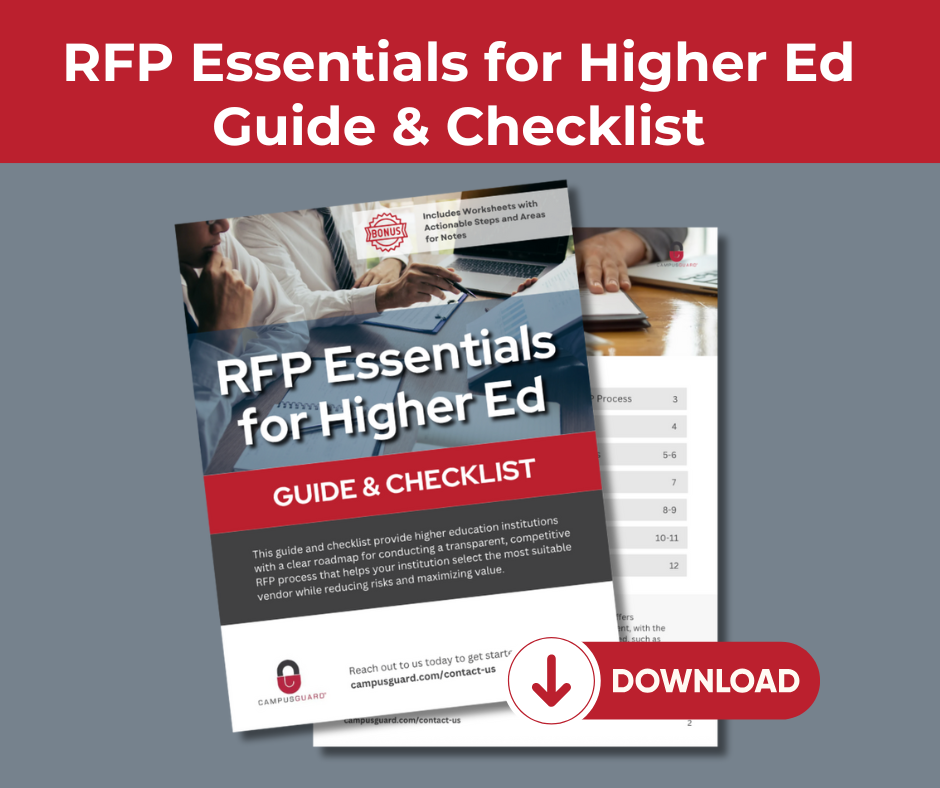
Access Our RFP Essentials for Higher Ed Guide & Checklist
Need help managing your RFP process?
This guide and checklist provide higher education institutions with a clear roadmap for conducting a transparent, competitive RFP process that helps your institution select the most suitable vendor while reducing risks and maximizing value.
This download contains:
- RFP Examples for Higher Education Institutions
- A Sample RFP Process
- Tips for a Successful RFP Process
- RFP Frequently Asked Questions
- Higher Education RFP Process Checklist
- Additional help & resources
Take the Guesswork out of your RFP Process
CampusGuard’s RFP Consulting Services offer comprehensive, end-to-end RFP management, with the flexibility to select only the support you need, such as evaluation assistance or contract review, tailored to your specific requirements.
Top RFP Consulting Services FAQs
An RFP (Request for Proposal) is a document used to solicit detailed proposals from vendors when an organization needs to purchase a product or service. It outlines requirements, expectations, evaluation criteria, timelines, and submission instructions.
An RFP is typically used for complex purchases, major technology investments, long-term service contracts, or situations where fair competition, transparency, or compliance with procurement policies are required.
RFP consultants help draft the RFP, refine requirements, manage timelines, coordinate vendor communications, facilitate scoring, and guide final selection. They bring expertise, objectivity, and efficiency to the process.
Common RFP pitfalls include vague requirements, unrealistic timelines, unclear evaluation criteria, overlooking long-term needs, and failing to involve key stakeholders early in the process.
For more details, check out our article, 10 Common Mistakes in RFPs and How to Avoid Them.
Yes. Many institutions, particularly public universities, must adhere to strict procurement policies to ensure transparency, fairness, and compliance. An RFP ensures those requirements are met.
Issuing an RFP has many benefits, including:
- Better Decision-Making: Organizations receive a range of options and can compare offerings side by side.
- Cost Savings: Competitive bidding can drive down prices and increase value.
- Risk Mitigation: Thorough evaluation and documentation help reduce the risk of project failure.
- Innovation: By encouraging vendors to propose their best ideas, organizations may discover new approaches or technologies.
- Fairness: The process levels the playing field, giving all qualified vendors an equal opportunity.
Yes, organizations can cancel an RFP if circumstances change, funding is no longer available, or no suitable proposals are received. Notice is typically provided to all participating vendors.
No. You can select an award to a bidder. You can cancel the RFP if you’re no longer interested. You can have an extension or postpone the RFP. You can also cancel the RFP if the responses didn’t meet your needs.
Key stakeholders typically include project managers, procurement teams, legal, treasury teams, accounting teams, IT teams, subject matter experts, and executive leadership.

10 Common Mistakes in RFPs and How to Avoid Them
Discover 10 of the most common mistakes organizations make in their RFPs, along with strategies to avoid them.
RFP Mistakes to Avoid about the 10 Common Mistakes in RFPs and How to Avoid Them