- Services
- Products
-
-
- Online Training
- Information Security Awareness Training Course
- PCI DSS Compliance Bundle
- GLBA Awareness Training Course
- CMMC Training Course
- HIPAA Awareness Training Course
- Data Privacy Training Course
- Payments Security Training Course
- Phishing Awareness Training Course
- GDPR Training Course
- FERPA Training Course
- FACTA Training Course
- Online Training
-
- Compliance
- Markets
- Insights
- About

The Cardholder Data Environment (CDE) is the heart of PCI DSS compliance. It is where cardholder data is stored, processed, or transmitted, together with the system components connected to it without restriction.
Payment card data moves through more systems than most organizations realize: every transaction, whether through an online checkout, a point-of-sale system, or a back-end billing platform, creates touchpoints where sensitive information is handled. Cardholder data, including primary account numbers (PANs), expiration dates, and cardholder names, is highly valuable and consistently targeted by attackers.
Defining your CDE accurately, and understanding how it differs from the broader set of systems that are simply in scope for PCI DSS, is the first step to protecting payment data and controlling compliance cost. A poorly defined CDE leads to unnecessary risk, a heavier compliance burden, and gaps attackers can exploit.
By clearly identifying where cardholder data lives and moves, organizations can reduce their attack surface, apply targeted security controls, and build a more efficient, cost-effective, and resilient approach to PCI DSS compliance.
Cardholder Data Environment (CDE)
Per the PCI SSC Glossary, a Cardholder Data Environment (CDE) is comprised of:
- The system components, people, and processes that store, process, or transmit cardholder data (CHD) and/or sensitive authentication data (SAD); and
- System components that do not store, process, or transmit CHD/SAD but have unrestricted connectivity to system components that do.
What Is a Cardholder Data Environment?
The cardholder data environment is defined by two things: the systems, people, and processes that actually handle cardholder data or sensitive authentication data, and any system components that connect to those systems without restriction.
In plain terms, the CDE is where payment card data is stored, accessed, and transmitted, plus whatever is directly and openly connected to it.
It is just as important to understand what the CDE is not. The CDE is not simply “anything that could affect the security of cardholder data.” That broader idea describes your PCI DSS scope, which is related but larger, as the next section explains.
CDE vs. PCI DSS Scope: Know the Difference
People often use “CDE” and “in scope” interchangeably, but they are not the same thing, and confusing them is one of the most common scoping mistakes. Your PCI DSS scope might be broader than your CDE. It includes the CDE and also any other system components that could affect the security of the CDE, even when those systems do not have unrestricted connectivity to it.
The Key Relationship
Everything in the CDE is in scope for PCI DSS, but not everything in scope is part of the CDE.
A system that could affect the security of the CDE but does not have unrestricted connectivity to it is in scope and must be secured and assessed in accordance with all PCI DSS requirements related to the connection(s)/service(s) being provided, yet it is not part of the CDE itself. Systems with no connectivity to, and no impact on, the CDE can be considered out of scope when they are properly isolated.
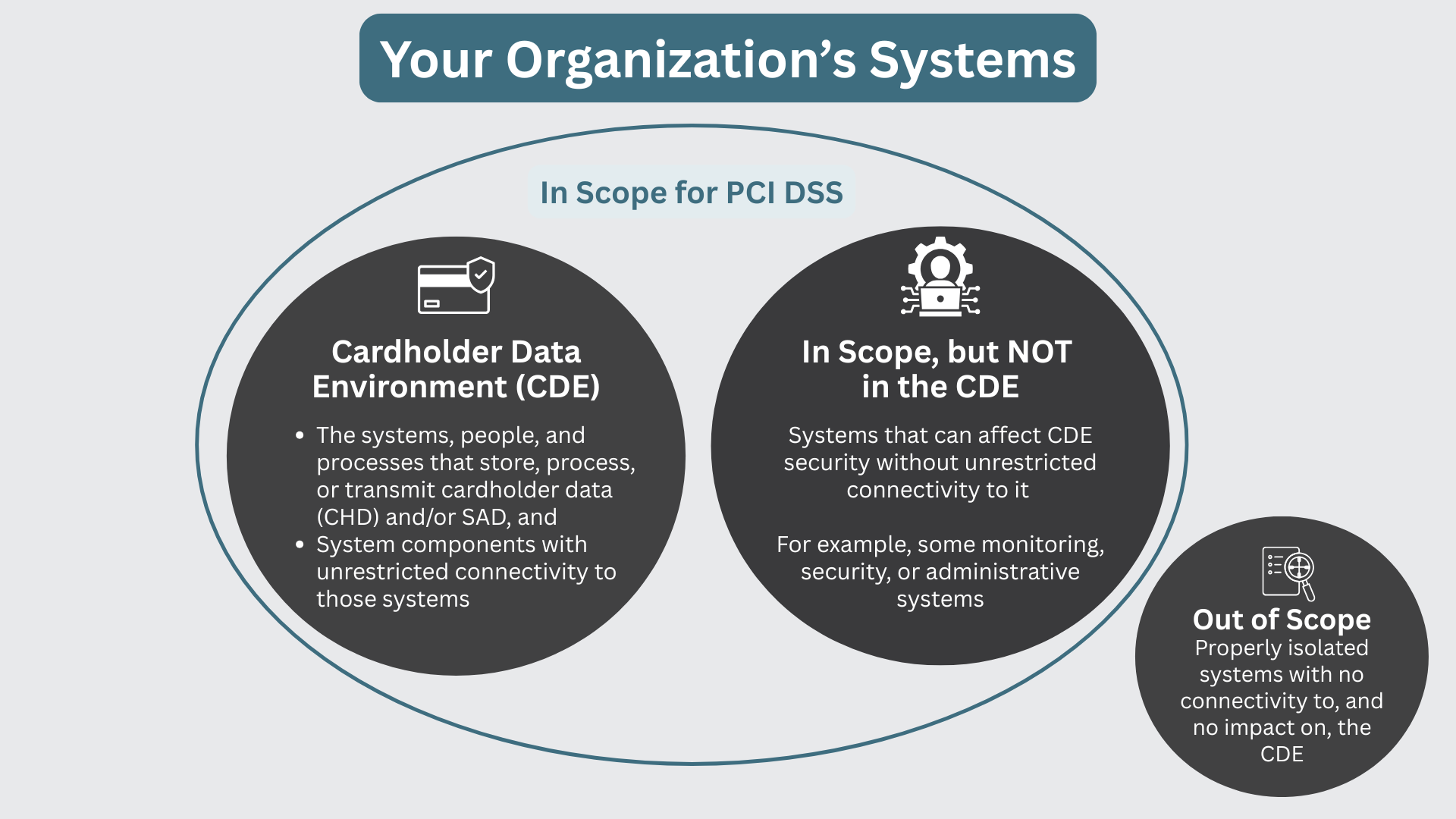
Scope includes the CDE plus other security-impacting systems. Proper segmentation keeps isolated systems out of scope entirely.
Getting this boundary right matters in both directions. Draw the CDE and scope too broadly, and you spend your limited time and budget securing and assessing systems that should not need it. Draw them too narrowly, and you leave real exposure and create findings at assessment time.
Why the Cardholder Data Environment Matters for PCI DSS
The CDE, together with the in-scope systems around it, defines where PCI DSS requirements apply. Every component within the CDE must meet strict security requirements that protect sensitive payment information. A well-defined cardholder data environment helps organizations:
- Prioritize security efforts where they matter most
- Reduce compliance complexity
- Limit exposure to cyber threats
- Strengthen overall data protection
Without proper scoping, organizations may include too many systems or miss critical ones, increasing risk and creating inefficiencies. An accurate CDE definition, built on the baseline above, is what makes the rest of a PCI DSS program manageable.
What Is Included in the Cardholder Data Environment?
Using the definition above, the CDE has two parts: the systems, people, and processes that handle cardholder data, and the components connected to them without restriction. It often extends beyond what organizations first expect.
Systems That Store, Process, or Transmit Cardholder Data
These directly handle payment information and are unambiguously part of the CDE:
- Point-of-sale (POS) systems
- Payment applications and gateways
- E-commerce checkout platforms
- Databases storing cardholder data
These systems are a primary target for attackers and require strong security controls, especially in modern digital payment environments where web payment platforms introduce both efficiencies and risks.
System Components With Unrestricted Connectivity
A component that does not itself store, process, or transmit cardholder data is still part of the CDE if it has unrestricted connectivity to systems that do. Examples can include administrative workstations, management systems, and certain infrastructure that sits on the same network segment as cardholder data systems.
The deciding factor is connectivity. If that same component is separated from the cardholder data systems by effective segmentation, so its connectivity is restricted, it may be in scope but not part of the CDE. If the access controls prevent communication between components, the components outside of the CDE are likely completely out of scope.
People and Processes
The CDE is not only technical. It also includes the people and processes that store, process, or transmit cardholder data:
- Employees who handle payments, such as cashiers
- IT and security staff who administer CDE systems
- The policies and procedures that govern how that data is handled
Human error remains a major risk factor, making training and awareness essential to maintaining a secure environment and protecting cardholder data.
A note on connected and security-impacting systems
Systems such as logging and monitoring platforms, network infrastructure (firewalls, routers, and switches), remote access solutions, and administrative workstations are frequently in scope for PCI DSS.
Whether they are part of the CDE depends on connectivity: they belong to the CDE when they have unrestricted connectivity to cardholder data systems, and are in scope but outside the CDE when they can affect its security without such connectivity.
Either way, they must be secured; the distinction determines which requirements apply and how.
How the Cardholder Data Environment Impacts Security and Risk
The size and complexity of your CDE directly shape your organization’s risk exposure and compliance effort.
A larger CDE means:
- An expanded attack surface
- More systems to secure
- Increased compliance demands
- Greater operational complexity
A smaller, segmented CDE means:
- Easier management and monitoring
- Reduced exposure to threats
- A lower compliance burden
- Stronger, more focused security controls
A smaller, well-defined CDE is also less expensive to maintain. Fewer in-scope systems mean lower annual assessment effort and cost, in both staff time and budget, freeing limited resources to support your organization’s core mission better. For this reason, many organizations work to reduce the size of their CDE by limiting where cardholder data exists and isolating it from the broader network.
How to Secure Your Cardholder Data Environment
Securing the CDE is most effective, and most affordable, when you tackle it in order. First reduce what you have to protect, then apply high-impact foundational controls to what remains, and finally complete and sustain the full set of required controls. Thinking in phases also helps you match effort to payoff.
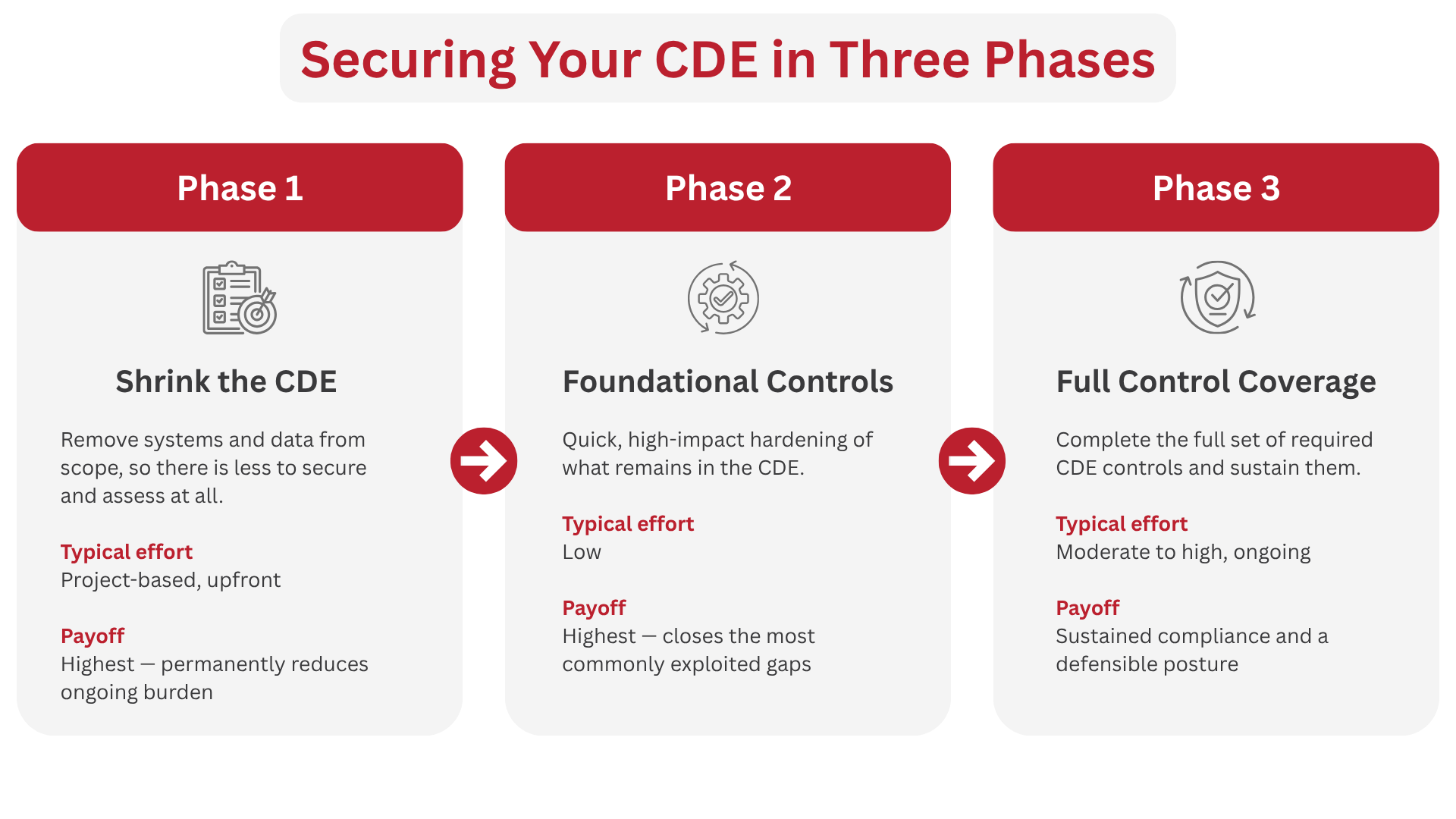
Phase 1: Shrink the CDE Strategically
The highest-leverage move is to remove systems and data from the CDE (and often from scope) altogether, because anything you take out is something you no longer have to secure, monitor, or assess. Common options include:
- Cease unnecessary payment acceptance, retiring channels, terminals, or methods you no longer need.
- Move e-commerce to fully outsourced payment pages (redirect or embedded iframe from a compliant provider) so cardholder data never touches your systems.
- Stop storing cardholder data, using tokenization or truncation so sensitive data does not persist in your environment.
- Implement a validated point-to-point encryption (P2PE) solution for card-present or mail-order/telephone acceptance.
- Segment the network to isolate the CDE from the rest of your environment.
Typical effort: project-based and largely upfront.
Payoff: the highest of any phase, because it permanently lowers ongoing security and compliance costs.
Phase 2: Implement Foundational Controls
Next, close the gaps that attackers exploit most often. These controls are comparatively quick to implement and deliver outsized risk reduction across whatever remains in the CDE:
- Remove or change all vendor-supplied defaults, including default passwords, accounts, and settings.
- Patch CDE components promptly, prioritizing critical vulnerabilities.
- Deploy and maintain anti-malware protection on applicable systems.
- Restrict inbound and outbound CDE traffic to only what is necessary (default-deny), reinforcing your segmentation.
- Establish and apply secure baseline (hardening) configurations.
- Maintain an accurate inventory of CDE components and up-to-date data flow diagrams.
- Assign unique IDs to every user and eliminate shared accounts.
Typical effort: low to medium.
Payoff: high, since these steps address the most commonly exploited weaknesses.
Phase 3: Achieve and Sustain Full Control Coverage
Finally, implement and maintain the complete set of PCI DSS controls applicable to your CDE, and keep them running over time. This phase is where a point-in-time fix becomes a durable program:
- Enforce multi-factor authentication (MFA) for all access into the CDE.
- Encrypt cardholder data at rest and in transit using current, industry-accepted methods.
- Enable comprehensive audit logging, and review and analyze logs (through daily review or automated alerting with follow-up).
- Add file integrity monitoring and change detection.
- Run quarterly internal and external vulnerability scans (external scans by an ASV) and at least annual penetration testing (external, internal, and both network- and application-based).
- Manage third-party service providers and remember that outsourcing never transfers your ultimate responsibility for compliance.
- Continuously monitor and reassess your CDE and scope whenever the environment changes.
Typical effort: moderate to high, and ongoing.
Payoff: sustained compliance and a defensible security posture. Appropriate controls from Phases 2 and 3 also apply to in-scope systems outside the CDE.
Why Securing the CDE Is Critical
Failing to properly secure the CDE can result in:
- Data breaches
- Financial penalties and fines
- PCI DSS compliance violations
- Reputational damage
- Loss of customer trust
Because every component in the CDE is interconnected, a single vulnerability can put the entire environment at risk.
Securing the Cardholder Data Environment: Key Takeaways
The CDE is the foundation of payment security and a core element of PCI DSS compliance. Defined accurately, it is the systems, people, and processes that handle cardholder data, plus the components connected to them without restriction, and it should be understood as distinct from, and smaller than, your overall PCI DSS scope.
Organizations that define their CDE accurately, distinguish it from scope, deliberately shrink it, and then secure it in phases can reduce risk, streamline compliance, lower cost, and strengthen their overall security posture. As threats targeting payment data continue to evolve, maintaining control over your CDE isn’t just about compliance; it is essential to long-term resilience and customer trust.
If you’re unsure where your cardholder data begins or how to secure it effectively, now is the time to act. Contact us today for assistance with your PCI DSS training and to strengthen your PCI DSS program. We provide PCI DSS assessments, client-side security to prevent e-skimming, and PCI DSS program management and development. We’re here to help!