- Services
- Products
-
-
- Online Training
- Information Security Awareness Training Course
- PCI DSS Compliance Bundle
- GLBA Awareness Training Course
- CMMC Training Course
- HIPAA Awareness Training Course
- Data Privacy Training Course
- Payments Security Training Course
- Phishing Awareness Training Course
- GDPR Training Course
- FERPA Training Course
- FACTA Training Course
- Online Training
-
- Compliance
- Markets
- Insights
- About
Every day, millions of phishing emails land in employees’ inboxes. Some are unpolished and obvious. Many are sophisticated, well-crafted, and designed to fool smart people under pressure.
And despite years of “don’t click suspicious links” reminders, human error remains the single most common cause of data breaches worldwide.
Conventional approaches such as increasing the number of posters in the break room or requiring additional compliance videos have been shown to be largely ineffective. What actually works is putting employees through the real experience in a controlled, safe environment: a phishing simulation.
This article provides a comprehensive overview of phishing simulators, including their functionality, intended users, and the essential features of an effective phishing simulation tool.
What Is Phishing?
Phishing is a type of social engineering attack in which an attacker impersonates a trusted entity, a colleague, a bank, a software vendor, or an HR department to trick the target into revealing sensitive information, clicking a malicious link, or downloading malware.
Modern phishing comes in several forms:
| Type | Description |
|---|---|
|
Email Phishing |
Mass-distributed fake emails mimicking trusted brands or senders. |
|
Spear Phishing |
Highly targeted attacks tailored to a specific individual or role. |
|
Whale Phishing |
Spear phishing aimed at executives and high-value targets. |
|
Smishing |
Phishing delivered via SMS text message. |
|
Vishing |
Voice phishing where attackers call and impersonate trusted parties. |
|
Quishing |
QR code phishing uses malicious links embedded in QR codes. |
|
Business Email Compromise (BEC) |
Impersonating executives or vendors to authorize fraudulent transactions. |
The Scale of the Problem
Before examining the solution, it’s worth sitting with the data. The human vulnerability to phishing is not a niche risk; it’s the dominant risk in enterprise cybersecurity today.
- 68–74% of data breaches involve a human element, with phishing as the most common trigger, according to Verizon DBIR 2025/IBM Cost of a Data Breach.
- According to the IBM Cost of a Data Breach Report 2025, the average cost of a phishing-related data breach in 2025 was $4.88M.
- There is a 3,000% increase in AI-generated deepfake phishing content between 2023 and 2025, according to Brightside AI.
What Is a Phishing Simulator?
A phishing simulator is software that lets organizations send realistic phishing emails to employees in a safe, controlled way.
The purpose is to assess vulnerability, provide timely training, and promote ongoing behavioral improvement through realistic practice.
How It Works: The Core Simulation Cycle
-
Baseline Assessment
A first wave of simulated emails is sent to all employees without warning. This establishes the baseline click rate and how many people are currently susceptible before any training.
-
Simulation Campaign
The platform sends ongoing waves of realistic phishing emails mimicking current real-world threats: fake IT alerts, invoice approvals, HR policy updates, CEO messages, and more.
-
Real-Time Tracking
The platform tracks who clicked, who opened, who submitted credentials, and who reported the email as suspicious.
-
Point-of-Error Training
Employees who click are immediately shown a short, contextual training module explaining what they missed and how to spot it next time. This is the most powerful learning moment.
-
Reporting & Analytics
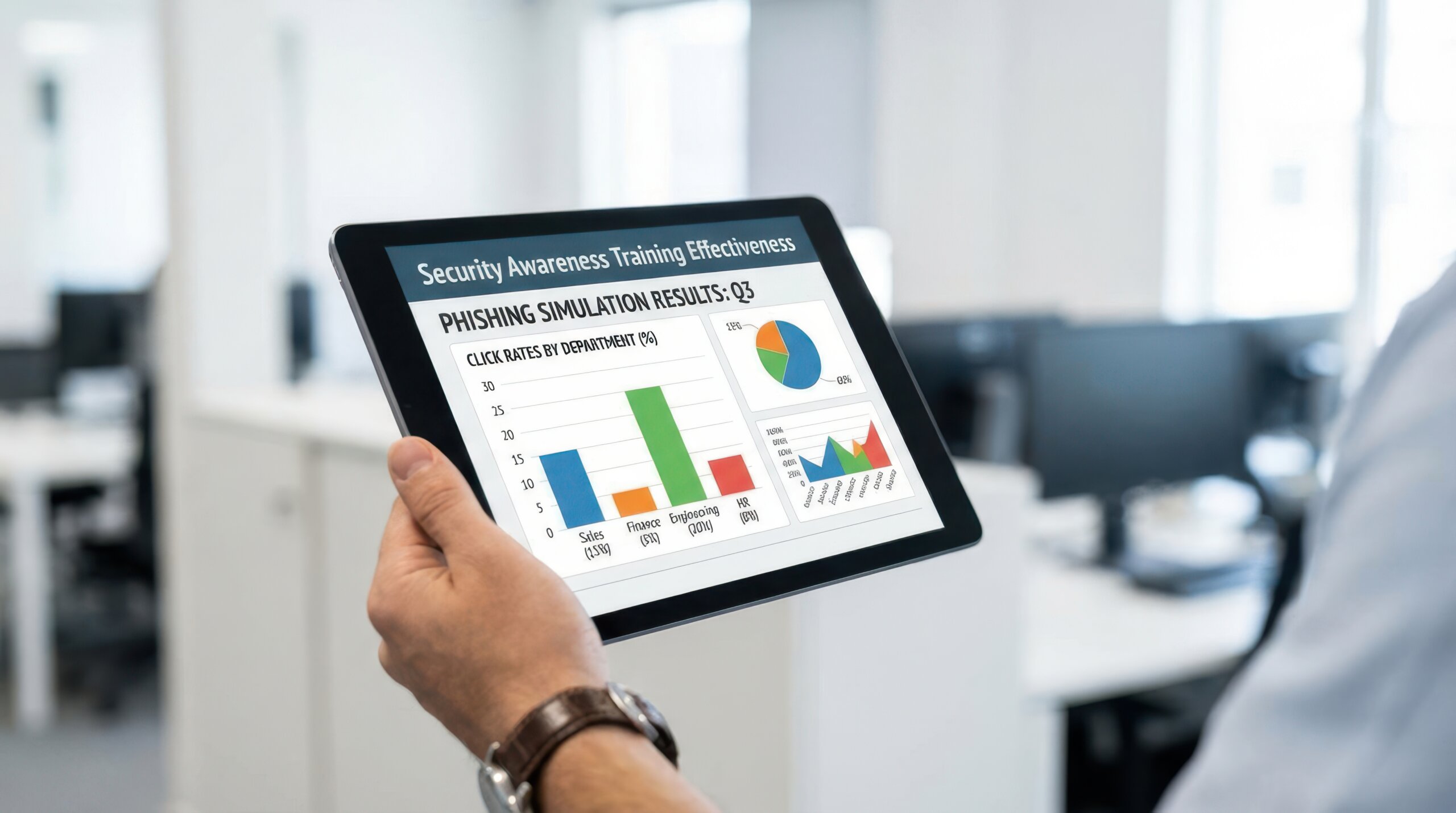
Administrators receive dashboards showing click rates by department, role, and individual, helping security teams identify high-risk groups and tailor interventions.
-
Ongoing Iteration
The cycle repeats with increasingly varied and sophisticated templates, tracking improvement over time and keeping employees alert to evolving tactics.
What Makes a Good Phishing Simulator?
Not all phishing simulators are created equal. The most effective platforms share several key characteristics:
- Realistic, continuously updated template libraries that mirror active real-world threats
- Role-based and industry-specific simulation scenarios
- Integration with the Report Phish button so users can report suspicious emails
- The ability to group and target users based on risk or role
- Immediate, in-context training triggered at the moment of failure
- Multi-channel coverage: email, SMS, voice (vishing), QR codes, and deepfakes
- Detailed analytics and reporting for security leaders and compliance documentation
- Integration with SIEM, HR systems, and identity platforms
Key Takeaways
- Phishing is the #1 cause of data breaches, and it targets humans, not technology.
- A phishing simulator sends safe, realistic fake phishing emails to your employees to test and train them in a controlled environment.
- One-third of untrained employees will click a simulated phishing email, making baseline simulation essential before you can measure improvement.
- Training delivered at the moment of failure is 40% more effective than generic awareness programs.
- The financial ROI is clear: preventing a single breach saves $725K–$4.88M against a program that costs $5K–$25K/year.
- Run programs with transparency and empathy. Punitive approaches backfire. The goal is a security culture, not a gotcha culture.
Final Thoughts
Phishing simulation isn’t a silver bullet. No single security tool is. But it is one of the few interventions in cybersecurity with documented, large-scale, independently verified results across millions of organizations and hundreds of millions of test data points.
The choice to phish your own users is ultimately a choice to take human vulnerability seriously. Not as a shameful weakness to be hidden, but as a known and manageable risk that can be systematically reduced through the right combination of experience, feedback, and repetition.
In a threat landscape where AI is supercharging attackers’ ability to craft convincing, personalized phishing campaigns at scale, the organizations that win will be the ones that invest just as deliberately in training their people as they do in hardening their infrastructure.
Your employees are your first line of defense. Phishing simulation makes sure they’re ready.
Ready to find out how many of your users would click today?
Contact CampusGuard to learn how our Phishing Simulator tool can help your staff in knowing how to detect and reply to phishing campaigns. Request a free demo or contact us to get started!
We also offer a Phishing Awareness training course to teach your employees how to proactively identify red flags and phishing indicators in email messages, and more.