- Services
- Products
-
-
- Online Training
- Information Security Awareness Training Course
- PCI DSS Compliance Bundle
- GLBA Awareness Training Course
- CMMC Training Course
- HIPAA Awareness Training Course
- Data Privacy Training Course
- Payments Security Training Course
- Phishing Awareness Training Course
- GDPR Training Course
- FERPA Training Course
- FACTA Training Course
- Online Training
-
- Compliance
- Markets
- Insights
- About

In part two of our series on building a human firewall against AI attacks, we dive into the actionable steps your organization can take to strengthen its defenses.
Actionable Steps to Implement
Use this step-by-step framework to put your human firewall strategy into motion, starting with where your current program falls short.
Step 1: Conduct a Training Gap Analysis
Audit your current security awareness program. Identify where AI-specific threats, deepfakes, AI phishing, and synthetic voice fraud are absent from your curriculum. CampusGuard’s security awareness training covers AI security and managing AI security risks, so your employees are up to date on the latest threats.
- Review existing training modules for coverage of deepfakes, AI phishing, and synthetic voice fraud
- Interview department heads to surface role-specific vulnerabilities
- Benchmark your program against current NIST and CISA guidance
- Prioritize gaps by risk level, highest-exposure roles first
Step 2: Define Your AI Threat Scenarios
Work with your security team to document the AI-based attack scenarios most relevant to your organization.
- Map threats to your highest-risk roles: finance, IT, HR, and executive assistants
- Review recent incident reports and threat intelligence feeds for higher education
- Document realistic attack scenarios your team could actually encounter
- Use these scenarios as the foundation for all training content
Step 3: Update or Rebuild Your Training Content
Develop or source training modules that specifically address AI-generated threats.
- Replace outdated content that focuses only on misspellings and suspicious links
- Prioritize scenario-based, visually rich formats over text-heavy slides
- Ensure content is updated as new attack vectors emerge
- Partner with a cybersecurity awareness provider, like CampusGuard, that is experienced in serving the needs of higher education institutions
Step 4: Launch a Phased Awareness Campaign
Roll out AI-focused awareness content in phases, starting with the highest-risk departments.
- Lead with short-form video and live sessions for immediate impact
- Follow with simulated AI attacks: synthetic voice calls, AI-generated phishing emails
- Distribute job aids, such as a quick-reference card for verifying suspicious requests
- Expand to institution-wide rollout once initial cohorts are trained
Step 5: Establish a Clear Reporting Protocol
Ensure every employee knows exactly how to report a suspected AI-generated attack.
- Make reporting frictionless — one click, one number, or one dedicated email address
- Communicate the protocol during onboarding and refresh it annually
- Acknowledge and celebrate reports to reinforce the behavior
- Track report volume and type to identify emerging threat patterns
Step 6: Measure, Adjust, and Repeat
Set baseline metrics before your campaign launches and use data to continuously improve.
- Track click rates on simulated phishing before and after training
- Monitor report rates, training completion, and time-to-report
- Share anonymized outcomes with leadership to demonstrate program value
- Schedule reviews to update content and re-test high-risk cohorts
Need assistance?
Contact us to learn how we can help you strengthen your human firewall strategy and protect your organization from AI attacks.
Download Strengthen Your Human Firewall in 6 Steps
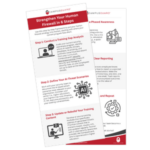 Follow this step-by-step framework to move your human firewall strategy from plan to practice, starting with identifying the gaps in your current program.
Access this infographic and share it with your teams.