- Services
- Products
-
-
- Online Training
- Information Security Awareness Training Course
- PCI DSS Compliance Bundle
- GLBA Awareness Training Course
- CMMC Training Course
- HIPAA Awareness Training Course
- Data Privacy Training Course
- Payments Security Training Course
- Phishing Awareness Training Course
- GDPR Training Course
- FERPA Training Course
- FACTA Training Course
- Online Training
-
- Compliance
- Markets
- Insights
- About

Cybersecurity technology has never been more sophisticated, and neither have the threats targeting your organization. Artificial intelligence is no longer just a tool for defenders.
Attackers are using it to craft hyper-personalized phishing emails, clone executive voices, generate convincing deepfake videos, and automate social engineering at scale.
Traditional security awareness training was built for a different era. Today’s threat landscape demands something more: employees who can think critically, question what they see, and act as an active layer of defense.
This is the concept of the human firewall, and building one is now a strategic imperative for every organization.
Key Takeaways
Before diving in, here are the most important points to keep in mind as you build your organization’s defenses against AI-generated threats.
- AI-generated threats are bypassing technical controls that once stopped traditional attacks, including spam filters, secure email gateways, and caller ID verification.
- Employees are often the last line of defense and the most frequently targeted.
- Security awareness training must evolve to address AI-specific attack vectors, including deepfakes, AI phishing, and prompt injection.
- A strong human firewall combines education, culture, and clear reporting protocols.
- Organizations that invest in AI-focused training measurably reduce their risk exposure.
Why AI-Generated Threats Are Different
Understanding what makes AI-powered attacks uniquely dangerous is the first step toward training employees to recognize and stop them.
- AI attacks differ from traditional threats in three important ways: speed, scale, and personalization.
- A threat actor using AI can generate thousands of unique, grammatically correct phishing emails tailored to each recipient’s name, role, and organization in minutes. They can clone a CFO’s voice with just a few seconds of audio pulled from a public video. They can create a deepfake video of a university president authorizing a wire transfer.
- These are not hypothetical scenarios. They are happening now, and they are succeeding, since many employees have not been trained to recognize them.
- The good news: humans are remarkably capable of detecting AI-generated content when they know what to look for. The challenge is closing the knowledge gap before attackers exploit it.
Best Practices for Building a Human Firewall
These strategies will help your organization move beyond outdated security training and equip employees to handle the realities of today’s AI-driven threat landscape.
- Update Your Training Content for the AI Era
Retire outdated modules that focus only on misspelled emails and suspicious links. Add dedicated content on AI-generated phishing, deepfake audio and video, and AI-assisted pretexting. Use real-world examples; employees learn best when they can see what threats look like. - Teach Verification, Not Just Recognition
Employees should not rely solely on visual or auditory cues to trust a message. Train them to verify through a secondary channel, call back using a known number, confirm via a separate communication platform, or check with a supervisor before acting on any unusual request. - Create Psychological Safety Around Reporting
Employees who fear blame are less likely to report suspicious activity or admit they almost fell for an attack. Build a culture where reporting is celebrated, not stigmatized. A near-miss reported is a breach avoided. - Run Simulated AI-Based Attacks
Tabletop exercises and simulated phishing campaigns are standard practice. Now add simulated AI scenarios: synthetic voice calls, AI-generated email campaigns, or deepfake video alerts. The goal is not to trick employees; it is to prepare them. - Keep Training Frequent and Relevant
Annual training is not enough. AI threats evolve quickly. Deliver short, targeted awareness content monthly or quarterly, and update it as new attack vectors emerge. Micro-learning formats, brief videos, quizzes, and scenario prompts are more effective than long annual modules. - Involve Leadership Visibly
Security culture starts at the top. When organizational leaders participate in training, talk openly about AI risks, and model secure behaviors, employees take the message seriously.
6 Steps to Strengthen Your Human Firewall
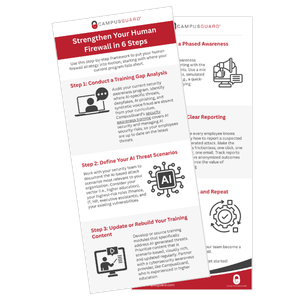 Check out our article on 6 Steps to Strengthen Your Human Firewall and download the infographic to share with your teams.
Final Thoughts
The technology defending your organization is only as strong as the people operating it. Firewalls, endpoint protection, and AI-powered threat detection are critical, but they are not infallible. Attackers know this, and they are increasingly targeting employees as the path of least resistance.
Building a human firewall is not a one-time initiative. It is an ongoing investment in your people, your culture, and your organization’s resilience. When employees understand AI-generated threats and feel empowered to act on that knowledge, they become one of your most powerful security assets.
The question is not whether your organization will face an AI-powered attack. The question is whether your team will be ready when it does.
CampusGuard helps organizations build security awareness programs designed for today’s threat landscape. Our penetration testing services go beyond the basics, specifically assessing your organization’s exposure to AI-generated attacks before they strike.
To learn how we can help your team become a stronger human firewall, contact us for guidance.